A Darle 20
A marketplace for tabletop game sessions in Latin America.
In plain terms
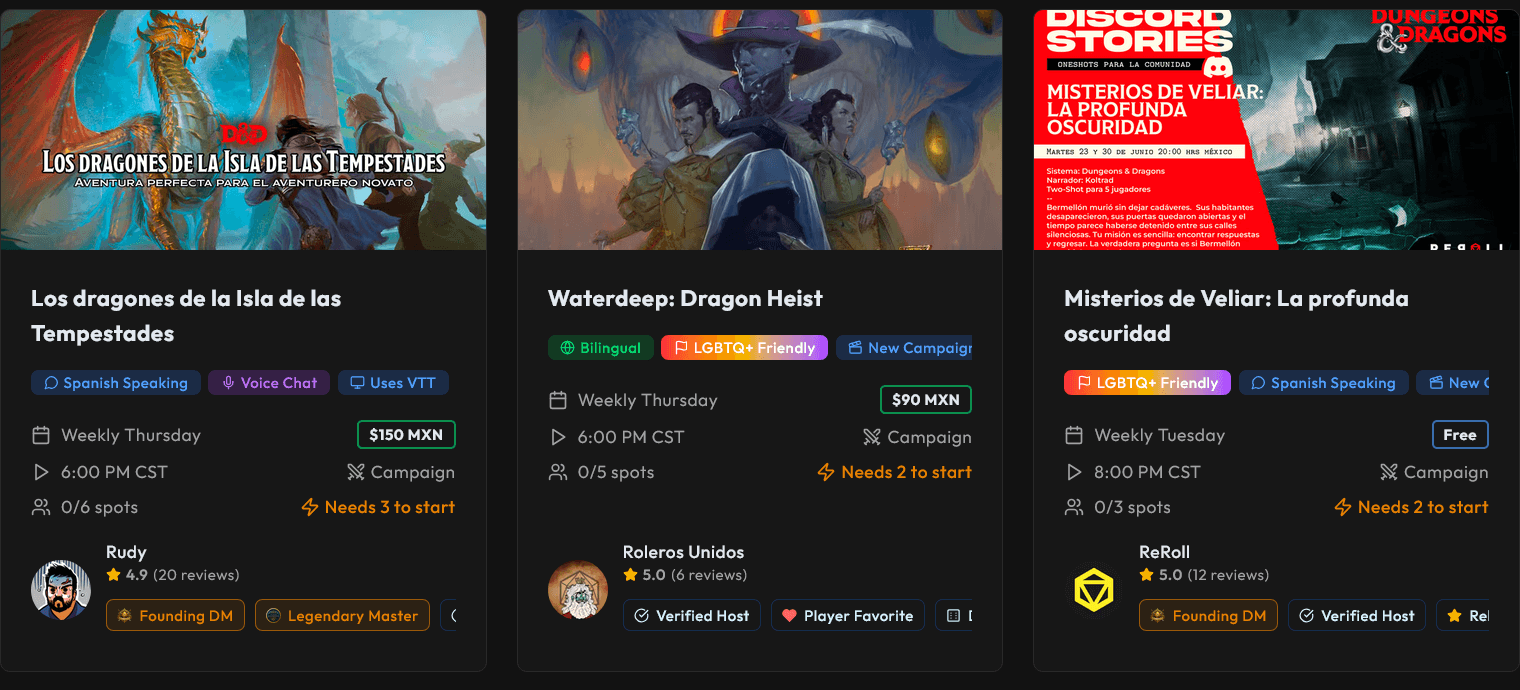
Tabletop roleplaying games are played in groups, and somebody has to run the game for everyone else. Finding a good one — and paying them — was word of mouth and a private arrangement. A Darle 20 is where that arrangement happens instead: a host lists a session, a player books a seat, the payment goes through the site, and both sides get an email about it.
The booking form is the easy part. The hard part is money. It has to reach the host rather than sit with the company, some players have no card at all and pay cash at a convenience store instead, and any of it can be cancelled or refunded by someone who isn't you. Most of what's described below is the machinery for handling that without a person in the middle.
The problem
Tabletop roleplaying games are big in Latin America, but finding a good game master — and paying one — was informal and unreliable. Hosts had no clean way to take bookings or get paid, especially in a market where many players prefer cash. Two friends and I decided to build the marketplace ourselves.
What I built
I architected and shipped the product end to end: host profiles, session listings, bookings and reservations, real-time chat, email notifications, refunds, and authentication. Payments run on Stripe Connect, handling host payouts and platform fees — including OXXO integration so players in Mexico can pay in cash at a convenience store, which matters in a market where card penetration is low. The funnel is instrumented end to end — bookings, conversion, cancellations, refunds, host activation — and that data steers product and monetization decisions.
The build itself is part of the story. I run an AI-agent-heavy development workflow in Claude Code — agents write most of the code, while I keep hands-on ownership of architecture, product decisions, code review, and release. Later I set up a multi-agent workflow that reviews, refactors, and regression-tests the codebase on its own.
What it runs on
TypeScript, React and Next.js, Supabase (PostgreSQL) with Prisma, Stripe Connect, Resend for transactional email, deployed on Vercel.
Where it stands
Development started in August 2025; the platform launched in March 2026. Four months in, it has 1,400+ registered users, 127 hosts, and 2,100+ bookings, with 200–400 unique visitors a day. The biggest single test so far was a flagship 251-player event at a 19,000-attendee convention — I built the technology behind it; my co-founder ran the event on the ground — rated 4.96/5 by attendees. Running it has taught me as much about unit economics as about code: we've tested a commission model against direct event ticket sales and made real decisions about where the margin actually is.
What I'd tell a hiring manager
This is the project that proves I can take an ambiguous idea to a revenue- generating product — including the unglamorous parts like refunds, payment edge cases, and infrastructure costs.
Everything in it
The prose above is the story. This is the surface area — what a host or a player can actually do.
- Discovery
- Host profiles
- Session listings
- Booking
- Bookings and reservations
- Cancellations
- Automated refunds
- Payments
- Stripe Connect
- Host payouts
- Platform fees
- OXXO cash payments at a convenience store
- Communication
- Real-time chat
- Transactional email on Resend
- Accounts
- Authentication
- Operations
- End-to-end funnel instrumentation — bookings, conversion, cancellations, refunds, host activation
What it looks like
Frames with nothing in them are waiting on a file. Each one says what it is for rather than showing a stand-in, because a placeholder that looks like a product is a claim about a product.